

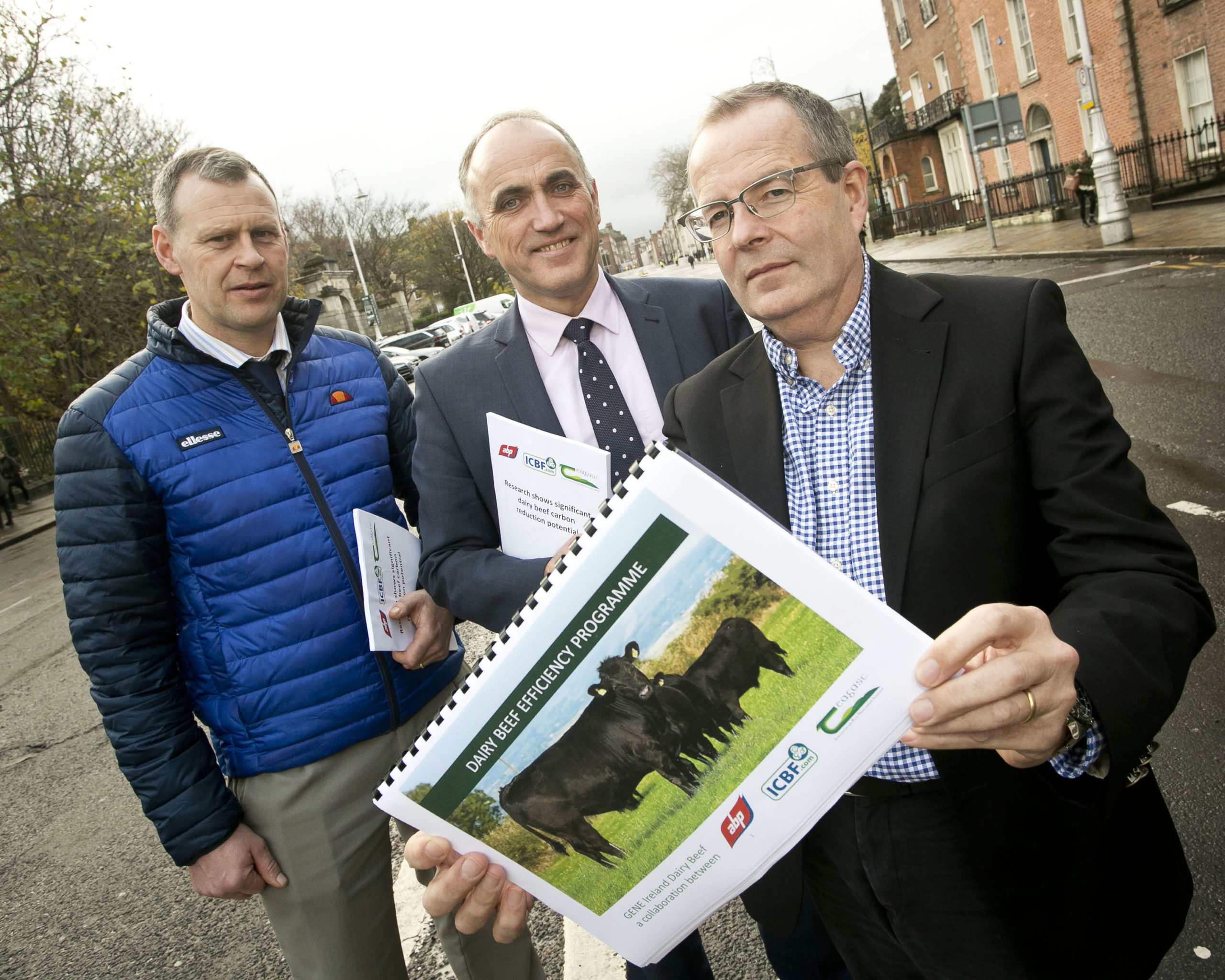
ABP Ireland, in conjunction with the Irish Cattle Breeding Federation (ICBF) and Teagasc has announced the latest results from its dairy beef genetic research programme, demonstrating a significant shift in carbon reductions in dairy beef.
The findings show the potential to:
- Reduce enteric methane emissions by up to 17% within cattle breed.
- Reduce enteric methane emissions by up to 28% across cattle breed.
- Reduce enteric methane reductions by up to 36% across different farming systems.
The study, the first of its kind in Ireland, examines the environmental and economic impacts of improved genetics on the dairy beef herd. The results also highlight the potential for improved yields of up to €200 on animal carcasevalues for beef farmers.
Commenting on the announcement, Dean Holroyd, group technical and sustainability director, ABP said: ““These results include 5 years of data and can significantly reduce the carbon impact of the national dairy beef herd without having to reduce its size. It is clear that a carbon reduction opportunity exists through improved genetics and we believe that the application of these findings can have a significant role to play when it comes to agricultural greenhouse gas abatement as set out in the Government’s 2019 Climate Action Plan.”
Padraig French, head of dairy research at Teagasc said: “The production of beef from the dairy herd on pasture based systems is the most environmentally and economically efficient beef production systems in the world. This research has demonstrated that it can be made even more efficient by dairy farmers selecting the best bulls to produce these animals which are finished at a younger age with lower feed requirements. As the national dairy herd is now contributing over 60% of the beef animals the impact of dairy farmers selecting suitable beef sires has the potential to have a very significant impact on national livestock carbon emissions. This technology will have an even greater impact when combined with sexed semen which is moving closer to being commercially viable for widespread use.”
Adding to these comments, Andrew Cromie, ICBF technical director noted that the data collected and results established on the R&D farm, were now forming a critical components of the ICBF’s broader G€N€ IR€LAND Dairy beef program, including its plans for the future. “To date, over 50 beef AI bulls and some 7,000 dairy-beef progeny have been generated through that program with a random selection of these (approximately 600 animals/year across the various sires on test) then going onto the ABP R&D farm for detailed data collection. A further sub-sample of these (about 200/year), then progress to ICBF’s performance test station at Tully, where ICBF collects additional data on the feed intake, feed efficiency and most recently direct GHG output on each animal. This give us great confidence that outcomes from the study to-date are real and repeatable across the dairy beef industry. The challenge for ICBF is now to include these metrics (such as age at slaughter and enteric methane output), into our routine genetic evaluation and herd benchmark systems. We look forward to bringing these to the wider cattle breeding industry in 2020.
The results are a culmination of 5 years research carried out at the ABP R&D Farm in Wexford and the ICBF Performance Centre in Kildare. To date up to 3,000 animals have participated in the scheme.